In India all electrical equipments are designed for 230/400 volts single/three phase. Voltage variation is common phenomenon. The input voltage is generally low during day time and high during night hours. Apart from above, few months in year/ few days in a month/few hours in a day – the voltage is either low or high due to the following reasons.
- Holidays
- Agriculture load
- Peak hours
- Rainy days
- Weather conditions etc.
Therefore for smooth function, it is suggested to install AVC with 400 Volts + 15% or 400 Volts + 20% input voltage variation range i.e. 340-460 Volts or 320-480 Volts models.
Check:
- You check the failure rate Of Electrical Equipments such as bulbs, tubes, chokes, motors, contractor coils and electronic equipments etc.
- You check the voltage variation by installing the digital voltmeter at your security gate and note down the hourly reading of input voltage variation range for few days.
- Not down hourly reading of current and voltage of one motor operating at constant load for 2-3 days. From the different readings you will observe that the current drawn by the motor is minimum at 390/400 volts as compared to the current drawn at other voltages. This means that power consumed by the motor is minimum at 390 / 400 volts.
- Also not down hourly readings of voltage and KW from your electronic Energy Meter for 2-3 days. From the readings you will observe that KW is minimum at 390/400 volts in most of the readings as compared to the higher voltage.
If you find that the above collected details are true then you will certainly have the advantages after installing the Servo Voltage Stabilizer as mentions below:
The table below gives approximate quantitative advantages of Automatic Voltage Controller at various fluctuation levels
| Input Voltage Voltage Variation Bands | Approx. Reduction in Breakdown of Electrical Equipments | Approx. Power Saving Motor Load below 10HP | Approx. Power Saving Lighting Load |
|---|---|---|---|
| 380-400 Volts | Nil | Nil | Nil & No Servo Stabilizer Required |
| 400 – 420 Volts | 5% | 3% | 5% |
| 420 – 440 Volts | 40% | 5% | 10% |
| 440 – 460 Volts | 60% | 7% | 20% |
| 460 – 480 Volts | Lighting Load | 10% | 30% |
- At low voltage you will not be able to operate your machines at rated capacity resulting in lower production.
- You need to run the machine on DG set. The power cost of DG set is three times as compared to charge by electricity board.
Benefits of installing Automatic Voltage Controller on Lighting Load
By maintaining 380/210 volts-three/single phase output through AVC for lighting load, there will be definite saving in power bill & reduction in failure rate of lighting equipments. Higher the input voltage-more will be the savings. The overall effect on the brightness of the lamp at 210 volts will be negligible.
Payback Period
Owing to its high efficiency and associated benefits, the payback period for the cost of Servo Voltage Stabilizer is from 6-12 months depending upon the input voltage variation and number of working hours of the plant. The HIGHER the input voltage the SHORTER will be the payback period.
Advantage
- Reduction in breakdown of electrical equipments
- Reduction in MDI
- Energy saving
- Improvement in power factor
- Uniform quality of end product
- 80% Depreciation as per Income Tax Act.
Description of Powertek Make AVC
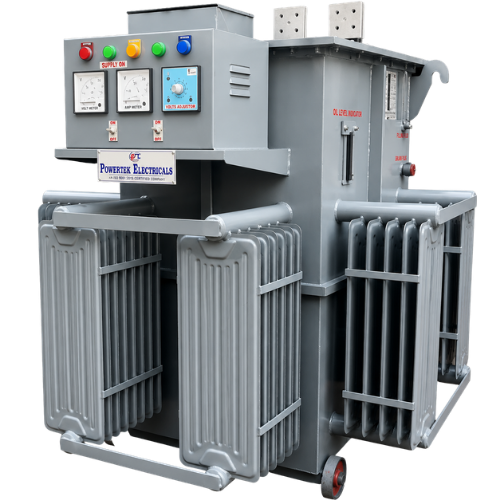
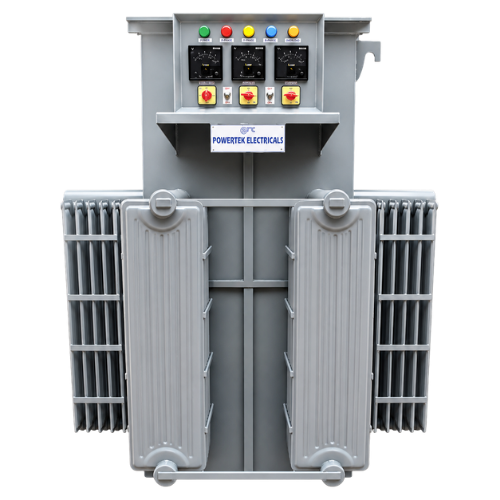
Powerteck Servo Voltage primarily consists of the following:
- Linear Type Plus/ Minus Vertical Rolling Contact Type Regulator
- Double Wound Back/Boost Transformer
- Electronic Control Circuit and meter panel.
The regulator and Buck/Boost transformer are oil cooled, housed in same or separate steel tanks. The radiators, if necessary are provided for effective cooling. Their core is built from grain oriented silicon steel laminations which keep losses to the minimum and they are wound with electrolytic grade cooper to minimize the losses, vacuum impregnated and oven dried as per IS standard.
Specification
Our AVC are available in a wide range and various models. The standard Three Phase models are suitable for balanced & unbalanced supply and loads. The standard models confirms to the following specification:
| Specification | Details |
|---|---|
| Input Voltage | 360 to 450, 350 to 460, 340 to 460, 340 to 480, 320 to 460, 300 to 460 |
| Efficiency (approx) | 99.5% 99% 98.7% 98.5% 98.25% 98% |
| Output Voltage | 400 V +/-1% 3-Phase, 50Hz |
| Cooling | Natural Oil Cooled |
| Type | Indoor/Outdoor |
| Temp. Rise (Max.) | 30 degree C above ambient temperature |
| Mounting | On Uni-direction wheels |
| Correction Rate | 6-8V/Sec (Upto 500 KVA) and 3-4 V/Sec. (Above 500 KVA) |
| Wave form distortion | Virtually Nil |
| Duty Cycle | 100% Continuous |
Note: Non-standard input and output models are available against specific requirements
Carbon Roller Assembly
Close view of Carbon Roller
Basic Circuit
Adverse Effects Of Single Phase
- The line current increase by 1.5 times.
- If the relay setting is at 15-20% higher than actual operating current then the relay will take 4-6 minutes to trip.
- The motor (particularly smaller capacity motors upto 7-5 HP) cannot withstand this high current for such a long time and in most of the cases it burns out before the relay trips.
- Heavy short circuit current flows through the relays, contactors, cables etc.
- Under this condition when the relay, contactor trips, they produce sparks and some time burst.
- This further damages the and in some of the cases may cause fire also.
Comparison between Powertek make & conventional make AVC
| “Powertek” Make Roller Type Regulator | Conventional Make with Brush Regulator |
|---|---|
| Power consumption is 0.5 to 1.5% depending upon the input voltage range. | Power consumption is 2 to 7% under similar conditions. |
| Suitable for continuous 100% duty cycle. | Suitable for only 30% to 40% duty cycle. |
| Life at full load is 15-20 years. | Maximum life is 2-3 years at full load. |
| Five years unconditional guarantee. | Normally guarantee for one year. |
| Negligible losses in full boost & buck condition. | Max. losses in full boost and buck condition. |
Attention for power consumer units having LT connections but not having their own distribution transformer and situated in commercial/residential areas:
It has been observed that the said power consumers usually face unbalanced input voltage problem and to overcome the same should install AVC suitable for unbalanced input voltage (individual phase control).
Attention for Industrial units having OLTC
The units which have already installed OLTC with their transformer also require stabilizer due to the reasons that the tapping of OLTC is not changed frequently. It is changed only when the problem of very high or very low voltage is felt. On the other hand, the stabilizer continuously monitors the output voltage level.
However the input voltage range Of stabilizer can be kept low where OLTC is installed.